1. Seamless Intelligence: Transforming Weld Robot Programming via CAD Integration
Traditional weld robot programming often involves tedious manual point collection or low-fidelity file imports that lose critical geometric data. iRobotCAM changes this by working directly within the 3D design environment.
● Automatic Feature Extraction: Because it shares the ZW3D engine, iRobotCAM can automatically “recognize” weld seams—such as fillet, lap, or butt joints—directly from the CAD model. This allows engineers to generate paths in minutes that would take hours in a manual environment.
● Unified Environment: Unlike Robotmaster, which acts as a heavy plugin for external CAM software, iRobotCAM provides a single-window experience. You design the part, define the fixture, and program the robot without ever switching applications.
2. Expert Process Control: Advanced Robot Welding Software for Complex Joints
Effective welding is defined by more than just movement; it is defined by the arc’s behavior. As a specialized robot welding software, iRobotCAM incorporates a deep “Process Library” that manages the intricate variables of the welding craft.
● Multi-Layer & Multi-Pass Logic: For heavy-duty robotic welding applications, such as shipbuilding or structural steel, iRobotCAM automates the generation of multi-pass paths. It calculates the offset and torch angle for every layer to ensure structural integrity.
● Dynamic Weaving Patterns: While Universal Robots excels in simple, collaborative tasks, iRobotCAM provides the industrial-grade control needed for complex weaving (Zig-zag, Circular, 8-shape) and torch attitude adjustments that are critical for managing heat-affected zones.
3. Integrated Synergy: Mastering Robotic Welding Systems and Multi-Axis Coordination
Modern welding cells are rarely just a 6-axis arm; they are complex robotic welding systems involving gantries, tracks, and rotary positioners. iRobotCAM is engineered to synchronize these movements perfectly.
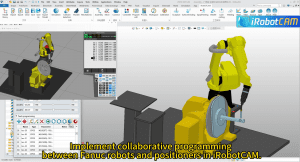
● External Axis Synchronization: iRobotCAM excels at coordinating the robot with linear tracks and positioners. It ensures the weld head remains in the optimal “flat” (downhand) position by automatically rotating the workpiece in sync with the robot’s movement.
● Collision-Free Automation: Within the scope of robotic welding automation, safety is paramount. The software performs real-time interference checks between the robot, the torch, the jigs, and the workpiece, virtually eliminating the risk of costly hardware damage on the shop floor.
4. Optimized Workflow: Advanced Robotic Welding Programming and Procedure Management
The true value of OLP is the ability to standardize quality. iRobotCAM acts as a comprehensive welding procedure software, allowing companies to digitize their welding expertise.
● Universal Post-Processing: Whether your floor uses FANUC, ABB, KUKA, Yaskawa, or domestic brands like Estun, iRobotCAM’s robotic welding programming module generates production-ready code tailored to the specific syntax of your controller.
● Virtual Commissioning: By validating the entire procedure in a virtual environment, manufacturers can predict cycle times with 99% accuracy and ensure reachability before the first spark is ever struck.